
Is MBBS Abroad Worth It in 2027? Advantages, Disadvantages and Career Opportunities Studying MBBS abroad…
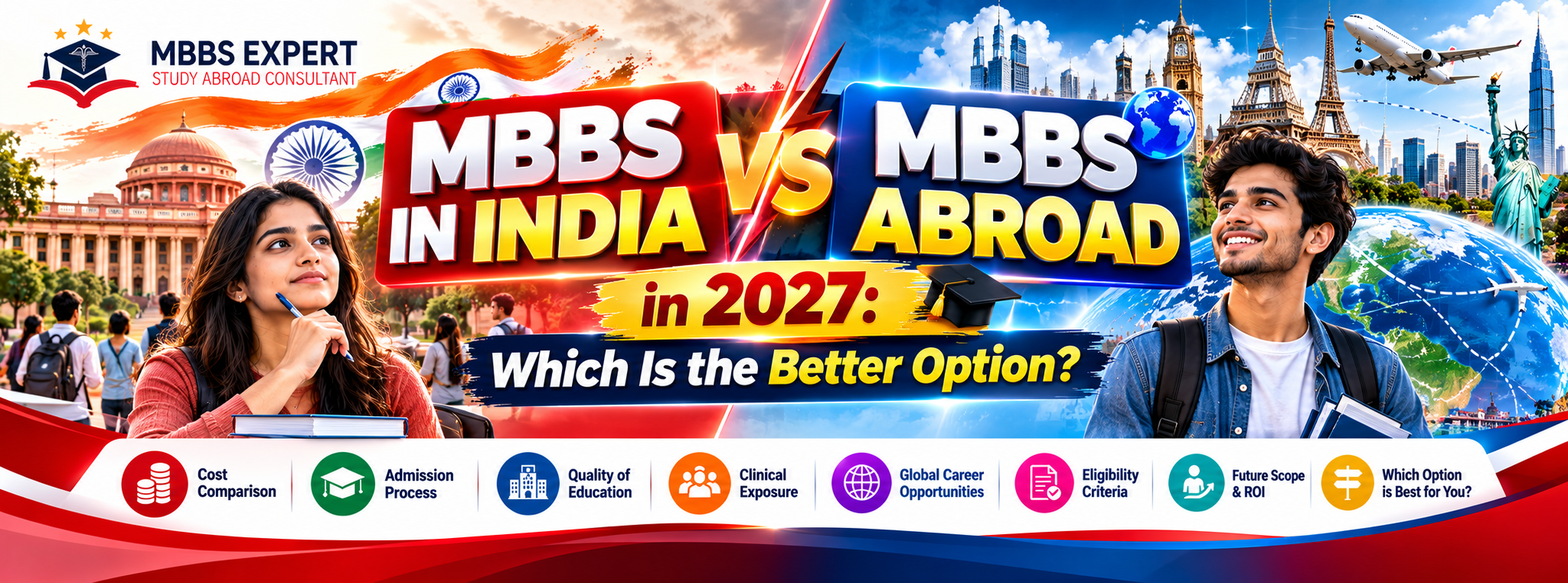
MBBS in India vs MBBS Abroad in 2027: Which Is the Better Option?

MBBS in India vs MBBS Abroad in 2027: Which Is the Better Option?
Selecting the right destination to pursue a Bachelor of Medicine and Bachelor of Surgery (MBBS) degree is a crucial decision for aspiring medical professionals, as it shapes their academic journey and future career opportunities.Every year, thousands of Indian students prepare for the National Eligibility cum Entrance Test (NEET) to secure admission to medical colleges. However, limited government medical seats, high private college fees, and increasing competition encourage many students to explore international medical education.
In 2027, the debate over MBBS in India vs MBBS Abroad will remain important for students and parents planning a medical career. Both options offer opportunities, but the right choice depends on budget, NEET performance, academic preferences, career goals, and willingness to study in a different country.
This guide compares MBBS in India and MBBS abroad in terms of fees, admission requirements, education quality, clinical exposure, lifestyle, and future career opportunities.
- MBBS in India: An Overview
India is a popular destination for medical education because students can study in a familiar environment, remain close to their families, and gain clinical exposure within the country’s healthcare system.
Medical colleges in India include government institutions, private medical colleges, and deemed-to-be universities. Government colleges generally offer affordable tuition, while private institutions may charge substantially higher fees.
Admission to undergraduate medical courses is based on NEET-UG, followed by the applicable counselling process. Competition is particularly intense for government seats because the number of applicants is significantly higher than the number of seats available.
Advantages of studying MBBS in India:
- Lower tuition fees at most government medical colleges.
- Education and clinical training within India’s healthcare system.
- Familiar language, food, culture, and lifestyle.
- Easier access to family support.
- No need to manage international travel, currency exchange, or residence permits.
- A direct pathway into the Indian postgraduate medical admission process, subject to applicable eligibility requirements.
The main challenges include intense competition for government seats and the potentially high cost of private medical education.
- MBBS Abroad: An Overview
MBBS abroad refers to pursuing a primary medical qualification at a university outside India. Popular destinations for Indian candidates include Russia, Georgia, Kazakhstan, Kyrgyzstan, Uzbekistan, Bangladesh, and Nepal.
These countries attract students through a range of tuition fees, international student communities, and English-medium medical programmes. However, admission requirements, course structures, clinical training, and living expenses differ between universities and countries.
Students considering MBBS abroad must carefully verify the university’s recognition status, course duration, internship arrangements, and compliance with the National Medical Commission’s regulations.
Advantages of studying MBBS abroad:
- Additional medical education options for students who cannot secure suitable seats in India.
- A range of tuition fees and living-cost options.
- International academic and cultural exposure.
- English-medium programe at selected universities.
- Opportunities to interact with students from different countries.
However, students must consider accommodation, food, travel, language barriers during clinical training, currency fluctuations, and the requirements for practising medicine in India after graduation.
- MBBS in India vs MBBS Abroad: Fee Comparison
Cost is one of the biggest factors when choosing between India and an international destination.
In India, government medical colleges generally provide the most affordable route to an MBBS degree. Private colleges can be considerably more expensive, depending on the institution, quota, state regulations, and applicable fee structure.
Abroad, tuition fees vary by destination and university. Some institutions offer comparatively affordable programmes, but students must calculate the total cost rather than comparing tuition alone.
| Expense | MBBS in India | MBBS Abroad |
| Tuition fees | Low at government colleges; potentially high at private colleges | Varies by country and university |
| Accommodation | Hostel or private housing | Hostel or rented accommodation |
| Food expenses | Depends on location and lifestyle | Depends on country and lifestyle |
| Travel expenses | Usually lower for students studying near home | International flights and local travel |
| Additional costs | Books, examinations, and living expenses | Visa, insurance, travel, currency exchange, and living expenses |
Which is more affordable?
A government medical college in India is often the most economical option. However, an international university may be financially competitive with certain private medical colleges. Students should compare the complete six-year budget, where applicable, including tuition, accommodation, food, travel, insurance, and other compulsory charges.
- Admission Requirements in 2027
Admission to MBBS in India
Students generally need to qualify for NEET-UG and satisfy the applicable eligibility criteria. Admission is determined through the relevant counselling process, merit, seat availability, reservation policies, and other rules.
Getting a government medical seat can be difficult because cut-offs vary by state, category, college, and counselling round.
Admission to MBBS Abroad
Indian students pursuing a foreign medical degree must meet the applicable NEET eligibility requirements and the relevant Indian regulatory conditions. They must also satisfy the destination country’s and university’s admission requirements.
Before paying any fees, students should verify the university’s official admission offer, programme structure, medium of instruction, internship arrangements, and compliance with the rules applicable to Indian students seeking registration in India.
Students should not assume that admission is guaranteed merely because they have qualified for NEET.
- Education Quality and Clinical Exposure
India has several highly regarded medical institutions with extensive patient exposure and established postgraduate training pathways. Clinical learning can be particularly valuable in colleges associated with busy teaching hospitals.
International universities also offer medical education and clinical training, but quality varies considerably. Students should investigate hospital affiliations, patient access, practical training, faculty qualifications, laboratory facilities, and the language used during clinical rotations.
Studying abroad does not automatically mean receiving a better education, just as studying in India does not automatically guarantee superior training. The quality of the individual medical college matters more than the country alone.
- Career Opportunities After MBBS
Students completing MBBS in India can pursue postgraduate medical education and other eligible career pathways, subject to applicable entrance examinations and registration requirements.
Students graduating from foreign medical universities who wish to practise in India must comply with the National Medical Commission’s applicable rules, including the requirements governing foreign medical qualifications, course duration, internship, and licensing or qualifying examinations.
Foreign graduates should not assume that their degree automatically permits registration in India. The applicable regulatory requirements should be checked before admission because non-compliance can create serious career difficulties.
Students interested in practising in another country must also meet that country’s licensing, examination, and registration requirements.
- Lifestyle and Student Experience
Studying in India offers familiarity, easier family access, and fewer cultural adjustments. Students can communicate comfortably in familiar languages and may find it easier to manage food preferences and daily routines.
Studying abroad encourages independence, cross-cultural communication, and international exposure. Nevertheless, students may experience homesickness, extreme weather, language barriers, and adjustment challenges.
Before choosing a foreign university, students should research student safety, accommodation, Indian food availability, transportation, healthcare access, and support services for international students.
- MBBS in India vs MBBS Abroad: Which Should You Choose?
Choose MBBS in India if you secure an appropriate government seat or a suitable private medical college within your budget. It can be especially beneficial if your long-term goal is to practise in India and you prefer studying in a familiar environment.
Consider MBBS abroad if you cannot secure a suitable Indian seat, have evaluated the financial commitment, and have identified a university that meets the applicable regulatory requirements. Carefully investigate its academic quality, clinical exposure, internship structure, and graduate outcomes.
Do not select a university solely because an agent promises guaranteed admission, low fees, or assured medical registration. Verify every important claim independently.
Related Posts